
Coarse Grind Coffee for Cold Brew: The Key to a Smooth Cup
Use a coarse grind for cold brew coffee, with a texture similar to rough sea salt or breadcrumbs. This large particle size slows extraction over the long 12-24 hour brew time, preventing the over-extraction of bitter compounds and ensuring a smooth, clean final concentrate that filters easily.
Most people get the texture wrong because they confuse “coarse” with “chunky.” They grind too fine, and the result is a muddy, bitter sludge that clogs filters. This guide walks through the exact settings for your grinder, how bean type changes the equation, and the simple visual test that guarantees a perfect coarse grind every time.
Key Takeaways
- A coarse grind is non-negotiable for immersion cold brew; it prevents over-extraction of bitter tannins and allows for clean filtration.
- Popular grinders have specific cold brew settings: Baratza Encore ESP uses 30-40, Fellow Ode Gen 2 uses 10, and the Comandante C40 MK4 uses 25-35 clicks.
- Lighter roast, denser beans may need a marginally finer grind within the coarse range compared to dark roasts for full extraction.
- Grinding too fine is the most common mistake; it leads to astringent, over-extracted coffee and a filtration process that can take hours.
- For drip cold brew systems, a medium-coarse grind is often better than an ultra-coarse one to maintain extraction efficiency with faster water flow.
Why a Coarse Grind Matters for Cold Brew
Cold brew extraction is a game of patience, not power. Without hot water to aggressively pull flavors, the process relies on time and surface area. A coarse grind creates fewer total particles with less collective surface area than a fine grind. This deliberately limits the rate of extraction.
Cold brew coffee extracts soluble compounds slowly over 12–24 hours. A coarse grind reduces the total surface area of the coffee, which in turn slows the extraction of bitter, astringent compounds like certain polyphenols and tannins that dissolve more readily in longer contact times. This results in a smoother, less acidic brew.
If the grind is too fine, you massively increase that surface area. The water over-extracts those harsh compounds long before the brew is done. You also create a thick bed of silt that either slips through a paper filter or forms an impermeable sludge that chokes a metal one.
TL;DR: Coarse grinds limit surface area to prevent bitterness during the long, cold extraction, giving you a smooth concentrate instead of a harsh, muddy one.
Finding Your Ideal Coarse Grind
“Coarse” is a range, not a single point. Your target texture should resemble rough sea salt or very coarse breadcrumbs. The grounds should feel distinctly gritty between your fingers, not powdery. They should not clump together when pinched.
For popular home grinders, manufacturers provide specific starting points.
| Grinder Model | Recommended Cold Brew Setting | Notes |
|---|---|---|
| Baratza Encore ESP | 30–40 on macro dial | This range is explicitly labelled for cold brew on the grinder’s adjustment collar. |
| Fellow Ode Brew Grinder Gen 2 | 10 (of 31 steps) | Fellow specifies this as the dedicated cold brew setting for this model. |
| Comandante C40 MK4 Nitro Blade | 25–35 clicks | This is the manufacturer’s French Press range, which serves as an ideal coarse benchmark. |
These are starting points. The actual perfect setting for your beans might be one click finer or coarser. Light roast Ethiopian beans are denser than a dark roast Sumatran. The denser bean might need a touch more surface area, a slightly finer grind within the coarse band, to fully extract over the same time.
Common mistake: Setting your grinder to “French Press” and assuming it’s perfect for cold brew. While close, some French press settings are a bit finer than optimal for a 24-hour cold steep, which can lead to slight over-extraction and a heavier mouthfeel.
The best test is in the cup. If your cold brew tastes weak or sour, grind a bit finer next time. If it’s bitter or harsh, grind coarser. Adjust in small increments.
The Tools You Actually Need (And One You Don’t)
Your grinder is the most important tool. A blade grinder cannot produce a consistent coarse grind. It creates a chaotic mix of boulders and dust. The fines will over-extract and clog your filter, while the boulders will under-extract, wasting coffee.
You need a burr grinder. The consistent particle size it creates is the foundation of good cold brew. This is the single upgrade that makes the biggest difference.
The other non-negotiable is a scale. Measuring coffee by volume with a scoop is hopelessly inaccurate for coarse grounds because they settle so loosely. A $20 kitchen scale ensures your coffee-to-water ratio is precise, which is critical for dialing in strength.
You do not need a dedicated “cold brew grinder.” Any quality burr grinder with a sufficiently coarse setting will work. The Baratza Encore ESP’s dedicated range is helpful, but an older Baratza Virtuoso or even a capable hand grinder like the 1Zpresso JX can hit the target.
A final, often-overlooked tool is a sieve or fine mesh strainer. After your main filtration, pouring the cold brew through a sieve catches the stubborn fines that slip through a standard filter, giving you an utterly clean final product.
Immersion vs. Drip: A Grind Size Adjustment
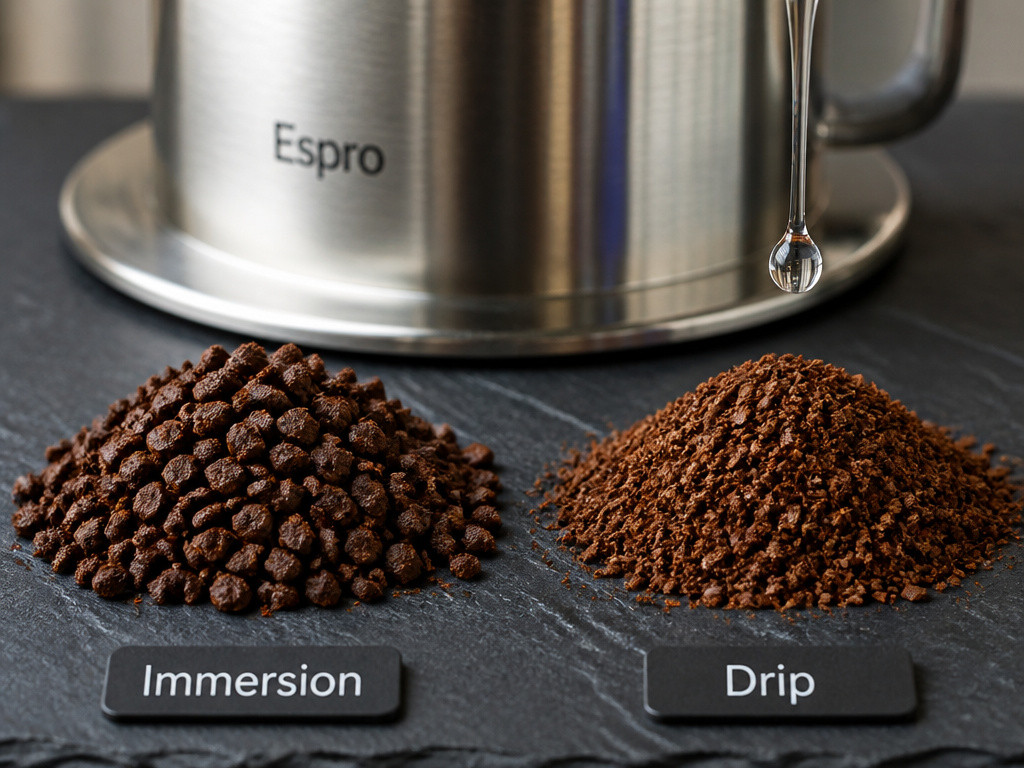
Not all cold brew is made the same way. The standard method is immersion, steeping grounds in water for half a day or more. For this, the classic coarse grind is king.
Drip cold brew systems, like those from Yama or Bruer, work differently. Water slowly drips through a bed of coffee grounds over a few hours. This is a percolation method, more akin to hot drip brewing but very slow and cold.
For drip cold brew systems, a medium-coarse grind often works better than an ultra-coarse one. If the grind is too coarse, the water channels through the bed too quickly, resulting in a weak, under-extracted brew. A slightly finer grind creates more resistance and better extraction within the shorter contact time.
The Toddy Cold Brew System, an immersion brewer, recommends a “coarse, cracked bean” consistency. This might be even coarser than a standard grinder’s French press setting. If your immersion brew tastes weak, don’t be afraid to go chunkier. The long contact time will still get the good stuff out.
How Bean Choice Changes the Grind
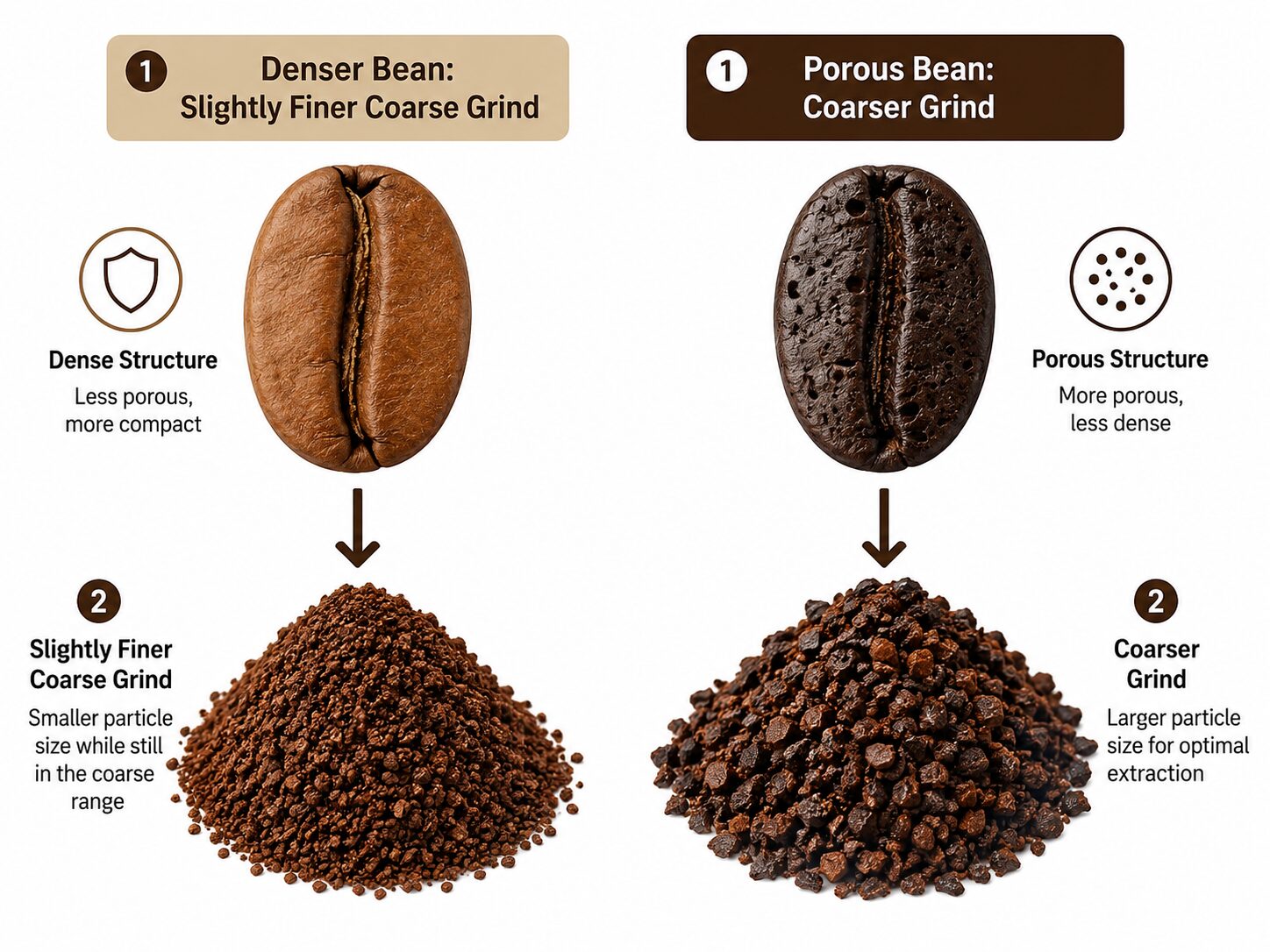
The bean itself dictates adjustments. Your grind setting is a response to the coffee’s density and roast level.
Lighter roast beans are denser. Their cellular structure hasn’t been expanded as much by heat. This makes them harder for water to penetrate. For a light roast, you might need to go a touch finer within the coarse spectrum to help extraction along. A super-coarse grind on a dense Ethiopian might leave you with a bright but thin and tea-like cold brew.
Dark roast beans are more porous and brittle. They extract much more easily. With a dark roast, you can, and should, use a coarser grind. A fine grind on a dark roast is a guarantee of bitterness. The porous structure gives up all its compounds, good and bad, very quickly.
This is why selecting your best beans for cold brew is a foundational step. A chocolatey, low-acid coffee blend meant for espresso will behave very differently than a fruity single-origin coffee from Ethiopia when ground coarse and steeped for a day.
The Science of Extraction: Why Time and Size Matter
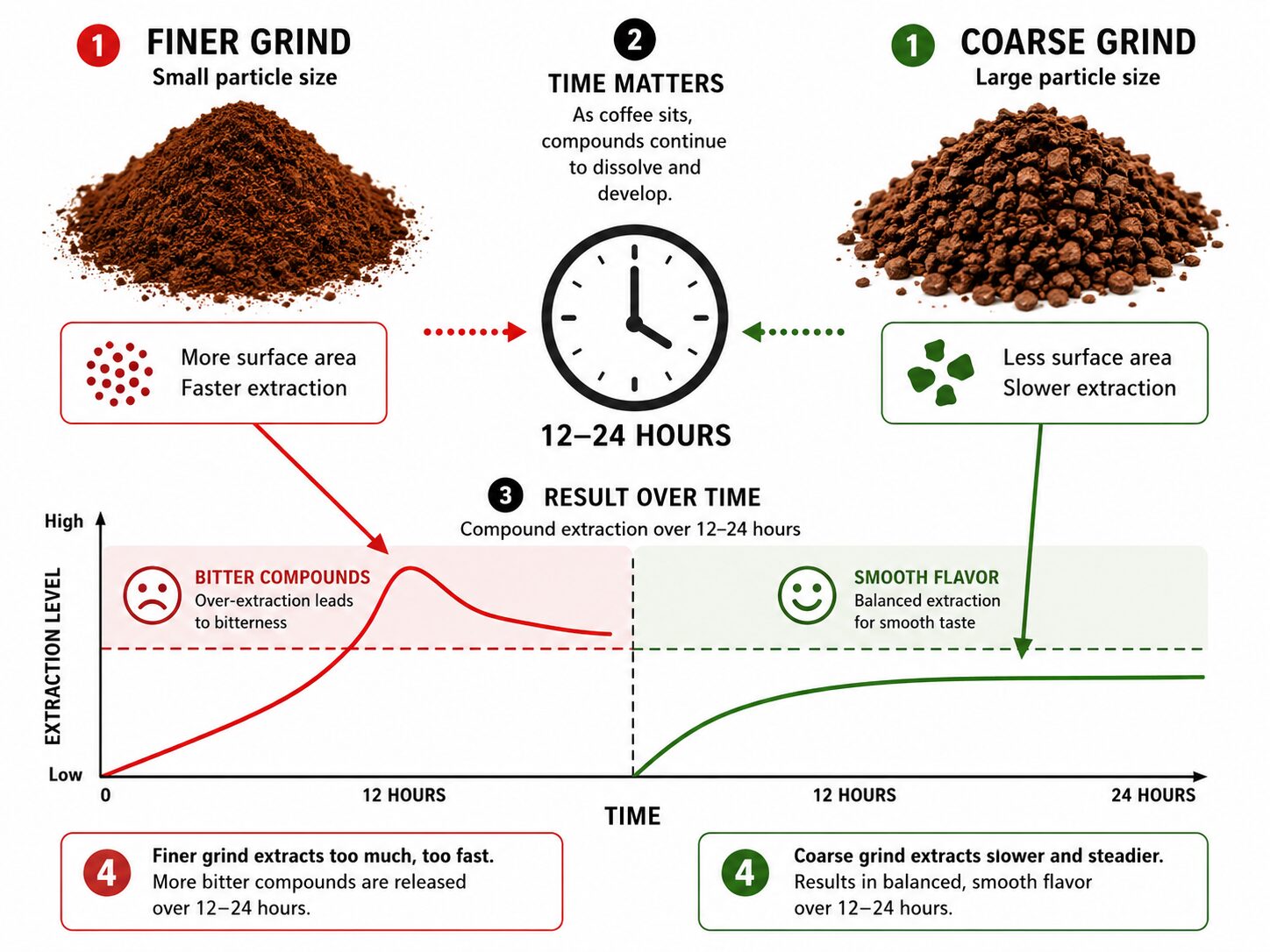
Cold water is a lazy solvent. It lacks the kinetic energy of hot water to quickly break down coffee cell walls and dissolve solids. A Scientific Reports study on grind size effect confirmed that grind size is a primary driver of caffeine and chlorogenic acid concentration in cold brew.
The study found that a finer grind increases extraction yield, but also increases the risk of extracting undesirable, bitter compounds if the contact time isn’t reduced proportionally. Since cold brew contact times are fixed and long (12-24 hours), you must use a coarse grind to balance the equation.
Another study published in the NIH coffee extraction optimization journal used a Central Composite Design to model cold brew. It highlighted that optimizing grind size, time, and ratio together is key for achieving the desired flavor profile, with coarse grinds being central to the preferred “smooth” characteristic.
This isn’t abstract. It explains why a fine grind makes cold brew bitter. The long time pulls out the harsh notes that hot brewing avoids by finishing in minutes. A coarse grind is your control mechanism.
Step-by-Step: Grinding for Cold Brew
Follow this sequence to eliminate guesswork.
- Choose and weigh your beans. Start with a 1:8 coffee-to-water ratio for a ready-to-drink strength, or 1:4 for a concentrate. Use 100 grams of coffee for 800 grams of water as a reliable batch size. Always weigh.
- Set your grinder. Consult the table above for your model’s setting. If you have a different grinder, find its coarsest setting and then back it off slightly. You want a clear, crunchy texture.
- Grind in batches if needed. Overfilling a grinder chamber can lead to uneven grinding, creating fines. For batches over 100g, split it into two runs.
- Inspect the grounds. Dump them onto a white plate. Look for consistency. You should see uniform, gritty particles. If you see a lot of fine dust (it looks like flour), your grind is too fine. If you see whole bean fragments, it’s too coarse.
- Store or brew immediately. Ground coffee stales quickly. Have your brewing vessel ready and transfer the grounds directly into your water. Don’t let them sit out.
Skipping the inspection step is how batches fail. Those fines will be the first thing to extract, turning your brew astringent. They are also the last thing to filter out.
Troubleshooting Your Cold Brew Grind
Your grind is the usual suspect when cold brew goes wrong.
- The brew is bitter and harsh. Your grind is too fine. The excessive surface area over-extracted during the long steep. Grind much coarser on your next batch.
- The brew tastes weak, sour, or thin. Your grind is likely too coarse. The water couldn’t extract enough flavor. Try a slightly finer grind within the coarse range. Also, consider your coffee bean origins; a dense, light roast might need this adjustment.
- Filtration takes forever or the filter clogs. This is a sure sign of too many fines from an inconsistent or too-fine grind. A consistent coarse grind from a burr grinder is the fix. Pre-filtering through a metal sieve can salvage the current batch.
- The cold brew is cloudy. Cloudiness comes from suspended fine particles and oils. A too-fine grind and/or inadequate filtration are the causes. A final pass through a paper filter or a finer metal filter will clear it up.
If you’re stuck without a proper grinder, a high-powered blender can pulverize beans, but it will create a wildly inconsistent mix. Pulse very briefly and sift the grounds to remove the finest powder. It’s a last resort, far inferior to even a modest burr grinder.
Frequently Asked Questions
Can I use pre-ground coffee for cold brew?
You can, but you lose all control. Pre-ground coffee is typically ground for drip machines, a medium grind that is too fine for optimal cold brew. It will work in a pinch, but expect a more bitter, less clean cup and a slower filtration. Always choose the coarsest pre-ground option available, often labelled “French Press.”
What happens if my grind isn’t consistent?
Inconsistency is the enemy. If your grind has both boulders and dust (common with blade grinders), the fines will over-extract and turn bitter while the boulders under-extract. The result is a simultaneously weak and harsh brew that misses the sweet, smooth target of good cold brew.
Does a coarser grind mean I need to use more coffee?
Not necessarily. The standard coffee-to-water ratios (1:4 for concentrate, 1:8 for ready-to-drink) account for the coarse grind and long time. If your brew is weak, adjust the grind finer before you increase the coffee amount. More coffee with too coarse a grind still won’t extract properly.
Is there a difference between cold brew and iced coffee grind?
Yes, it’s a massive difference. Iced coffee is typically hot-brewed coffee immediately cooled. It uses a grind appropriate for its hot brewing method (e.g., medium for pour-over). Cold brew requires a specifically coarse grind for its unique, long, cold extraction process. Using an iced coffee grind for cold brew will ruin it.
The Bottom Line
A proper coarse grind isn’t just a suggestion for cold brew; it’s the mechanism that makes the method work. It’s the reason cold brew can be smooth and low-acid where hot brewing might fail. Dialing in that grind, using specific settings, adjusting for your beans, and avoiding the silt, turns a good idea into a great cup.
Start with your grinder’s recommended setting. Taste the result. Let your palate tell you if you need to go a click coarser or finer. The goal is in the cup: a clean, sweet, full-bodied concentrate that stands up to ice and maybe a splash of your favorite sweeteners for cold brew. Once you taste the difference the right grind makes, you’ll never go back to guessing.
